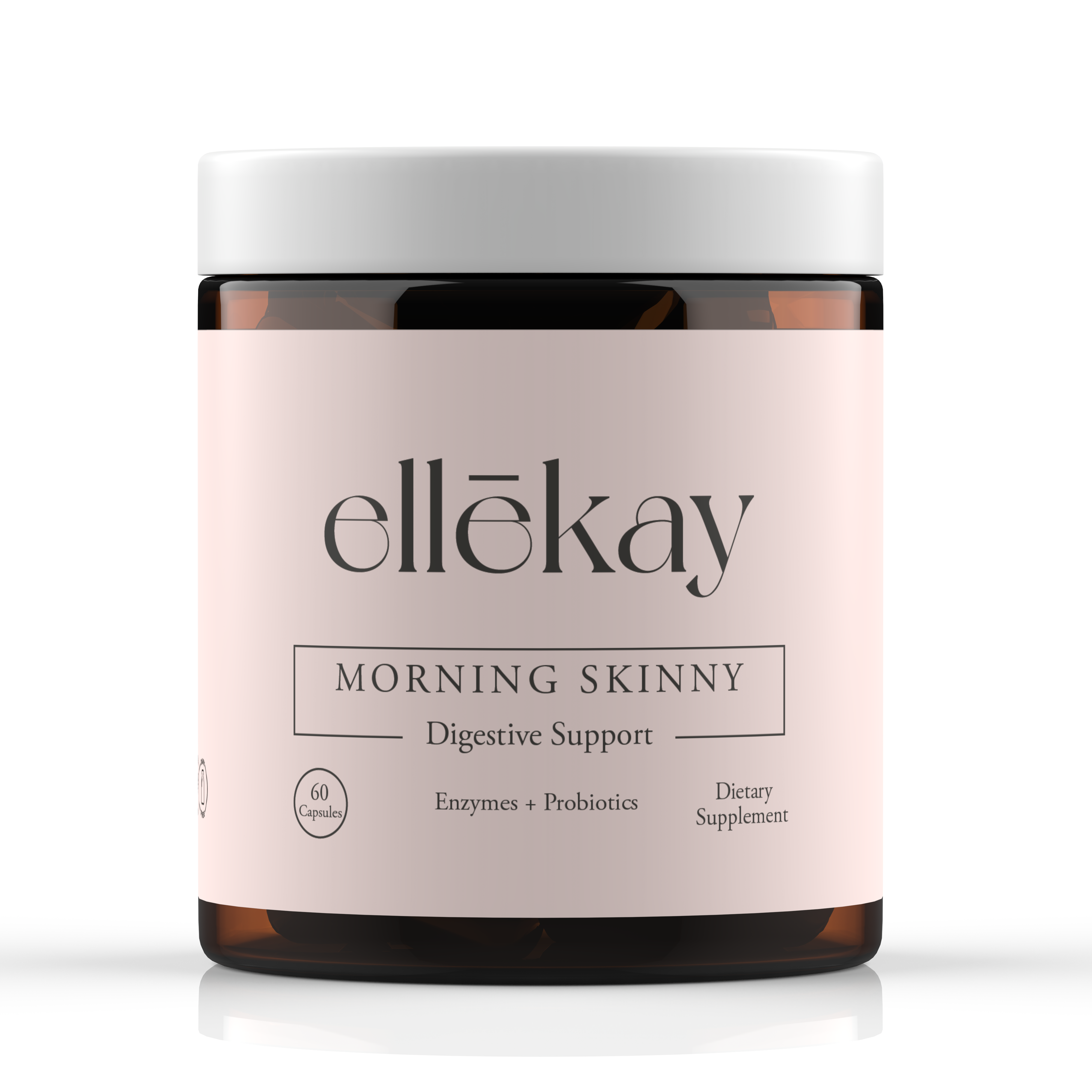
Learning how to read supplement labels helps you make smarter gut health choices every time you shop. A well-formatted supplement facts panel tells you exactly what goes into each dose, from serving size to daily value percentages, so you can compare dietary supplements with confidence. Ellekay's Morning Skinny is built on full label transparency for every ingredient.
By Ellekay Team, Women's Wellness Experts
What the Supplement Facts Panel Actually Shows You
The supplement facts panel is the standardized label the FDA requires on every dietary supplement sold in the United States. Think of it as the ingredient roadmap for what you're putting in your body.
Under the Dietary Supplement Health and Education Act (DSHEA) of 1994, manufacturers must present key information in a specific format. That structure exists to protect consumers: it standardizes what appears on supplement labels, how amounts are listed, and which daily value benchmarks apply.
The Header Section
At the very top of the supplement facts panel, you'll see the serving size listed clearly. This tells you how much of the product counts as one dose. Some gut health powders use a serving size of one scoop, while capsule-based products might specify two capsules per serving. The serving size is critical because every ingredient amount listed below it corresponds to that specific portion.
Immediately below that, you'll find servings per container (sometimes noted as servings per on older supplement labels). This tells you how many complete doses you get from one bottle or pouch. A product with 30 servings per container and one serving per day gives you a full month of support.
The Nutrients and Ingredients Grid
Below the header, you'll find a grid listing each active ingredient, the amount per serving, and the % daily value (DV). Daily value percentages are reference points based on a 2,000-calorie daily diet for adults, established by the FDA. A vitamin listed at 100% daily value means one serving delivers the full FDA reference amount for that nutrient.
Not every ingredient carries a daily value percentage. For proprietary blends, botanicals, or newer compounds like postbiotics, the column may show a dash or asterisk. An asterisk typically signals "daily value not established," which is common in gut health dietary supplements featuring specialized strains or novel ingredients.
How Serving Size Changes What You're Actually Getting
This is where many shoppers get tripped up. A product may advertise impressive ingredient amounts, but those amounts only apply when you take the full serving size, not a partial dose.
Always do the math. If a product lists 5 billion CFUs of Lactobacillus acidophilus per serving and the serving size is four capsules, a two-capsule dose delivers roughly 2.5 billion CFUs. That calculation matters when comparing gut health products or working toward a specific therapeutic range.
Concentrated vs. Standard Formulas
Some gut health products use concentrated extracts, where a smaller serving size delivers the equivalent of a much larger raw quantity. When comparing two digestive supplements, check whether one uses a 10:1 extract (ten parts raw ingredient concentrated into one) versus a standard powder. A smaller serving size built on a higher-potency extract can outperform a larger-scoop product built on a lower-grade ingredient form.
Powder vs. Capsule Absorption
Serving size also interacts with delivery format. Powders mixed into liquid often absorb faster than capsules, especially for gut-targeted ingredients that begin working in the upper digestive tract. Capsules protect acid-sensitive probiotics from stomach acid but add processing time. If you want to see how delivery format and serving size work together in a real formulation, visit the Morning Skinny product page for a full ingredient breakdown.
Reading Ingredients Beyond the Supplement Facts Panel
Knowing how to read supplement labels means understanding both sections: the supplement facts panel for active ingredients and the full ingredient list for everything else. The section labeled "Other Ingredients" appears below the main panel and deserves equal attention.
What "Other Ingredients" Includes
Other ingredients cover fillers, flow agents, capsule materials, and inactive components used during manufacturing. Common entries include rice flour, magnesium stearate, silica, and gelatin or vegetable cellulose for capsule shells. None of these are inherently problematic, but if you have sensitivities, this is exactly where they appear.
For gut health specifically, watch for artificial sweeteners like sucralose or acesulfame potassium in flavored powders. A 2019 study by Ruiz-Ojeda, Plaza-Diaz, Saez-Lara, and Gil published in Advances in Nutrition found that non-nutritive sweeteners may alter gut microbiome composition, working against what most gut health supplements aim to accomplish.
Allergen Disclosures
FDA-regulated supplement labels must disclose the presence of major allergens: milk, eggs, fish, shellfish, tree nuts, peanuts, wheat, and soybeans. These disclosures typically appear at the bottom of the facts label or within the "Other Ingredients" section. If you manage food sensitivities, this is a non-negotiable read before purchasing any new product.

Evaluating Claims on Supplement Labels
Supplement labels can carry two types of claims: structure/function claims and health claims. Understanding the difference helps you interpret product marketing accurately.
Structure/Function Claims vs. Health Claims
Structure/function claims describe how a nutrient or ingredient supports normal body function. Examples include "supports digestive health," "helps maintain a healthy gut lining," or "promotes regularity." These claims are legal as long as they are truthful, not misleading, and paired with the required disclaimer: "This statement has not been evaluated by the Food and Drug Administration. This product is not intended to diagnose, treat, cure, or prevent any disease."
Health claims describe a specific relationship between a nutrient and a diagnosed medical condition. These are far more tightly regulated and require FDA pre-approval. You'll encounter them far less frequently on dietary supplements than on packaged foods.
The Disclaimer Is Not a Warning
Many shoppers see the FDA disclaimer and assume it flags an unproven or risky product. It does not. That disclaimer is required on all dietary supplements regardless of how well-researched the ingredients are. It is a regulatory marker, not a quality signal.
What matters more is whether the brand supports its formulas with published, peer-reviewed research. Look for products that cite specific probiotic strains (such as Lactobacillus rhamnosus GG or Bifidobacterium longum), name the researchers behind their ingredient selections, and disclose the exact doses used in clinical studies rather than hiding behind vague "proprietary blend" totals.
Third-Party Testing and What Certifications Mean
The FDA does not approve dietary supplements before they reach shelves the way it approves pharmaceutical drugs. Manufacturers are responsible for product safety and accurate labeling, which makes third-party testing one of the most reliable quality indicators on any supplement facts label.
Recognizable Certification Seals
Certifications from NSF International, USP (United States Pharmacopeia), or Informed Sport signal that an independent lab has verified the product. These audits confirm that:
- The product contains what the supplement facts declare
- Ingredient amounts match what the label lists
- The product is free of harmful contaminants or undisclosed substances
GMP Compliance
You may also see "Manufactured in a GMP-certified facility." GMP stands for Good Manufacturing Practices, a set of quality standards the FDA enforces for supplement production. A GMP-certified facility has been audited for cleanliness, process controls, and ingredient verification. It confirms baseline manufacturing integrity, even if it does not guarantee a formula's effectiveness.
For women managing hormonal changes in midlife, label certifications can matter more since formulas and dosing needs often shift with age, a shift we explore further in gut health after 50.
Certification is not necessarily tied to price. GMP-certified and third-party-tested products exist across price tiers, so shoppers working within a tighter budget should prioritize the certifications above over paying more, rather than assuming a higher price guarantees better testing.
How to Read Supplement Labels When Comparing Products
Once you can interpret a supplement facts panel fluently, comparing products becomes far more straightforward. Here is a practical three-step process.
Step 1: Normalize by Serving
Never compare raw ingredient totals from different products without adjusting for serving size first. If Product A lists 20 billion CFUs per two capsules and Product B lists 10 billion CFUs per one capsule, they deliver the same amount per capsule. This normalization step eliminates a large category of label confusion.
Step 2: Identify Researched Ingredients
For gut health dietary supplements, look for ingredients backed by published research: probiotic strains identified by genus, species, and strain code (such as Lactobacillus acidophilus NCFM), prebiotic fibers like inulin or fructooligosaccharides, and digestive enzymes like protease, amylase, or lipase. A vague entry like "probiotic blend" without strain-level disclosure makes it impossible to verify the science behind a formula.
Step 3: Check Potency at Time of Use
Probiotics are measured in CFUs (colony-forming units), and live cultures degrade over shelf life. Look for labels that guarantee potency "at time of use" or "through end of date," not just at time of manufacture. A product listing 50 billion CFUs at manufacture may deliver far fewer by the time you open it, depending on storage conditions.
For women who train regularly, probiotic potency and supplement timing around exercise deserve extra attention, since training intensity can affect gut transit and absorption. Gut health for athletes digs into building a supplement routine around a training schedule.
Timing also matters at the lifestyle level. When you take a supplement relative to meals can affect how well it absorbs, so a shifting meal schedule can shift that relationship too. If your eating pattern varies day to day, anchoring your supplement to a consistent time, rather than a consistent meal, is usually the easier habit to build, and a healthcare provider can help you fine-tune timing for your specific routine.
Frequently Asked Questions
What does "daily value" mean on supplement labels?
Daily value is a reference number set by the FDA based on average adult nutritional needs on a 2,000-calorie diet. A percentage of 100% means one serving provides the full FDA reference amount for that nutrient. Higher percentages are common and not always a concern, though whether they matter depends on whether the vitamin is fat-soluble (accumulates in tissue) or water-soluble (excreted in urine).
What is a supplement facts panel vs. a nutrition facts panel?
A supplement facts panel appears on dietary supplements, while a nutrition facts panel appears on conventional foods. The supplement facts version includes a dedicated section for dietary ingredients and their amounts, and it follows different FDA formatting requirements. Both are regulated, but the legal frameworks governing each differ under separate federal rules.
Why don't all ingredients have a % daily value listed?
Ingredients without established reference intakes, including many botanicals, probiotic strains, and newer functional compounds, show a dash or asterisk in the daily value column. This signals that no population-wide daily reference has been formally set for that ingredient, not that the ingredient is unresearched or ineffective.
How many servings per container should a gut health supplement have?
Most gut health supplements are designed for daily use, so look for products with at least 30 servings per container (one month's supply). Products with fewer servings per container require more frequent reordering, raise your per-dose cost over time, and can interrupt the consistency your gut needs for long-term results.
Is it safe to take a dietary supplement with 500% daily value of a vitamin?
It depends on whether the vitamin is fat-soluble or water-soluble. Fat-soluble vitamins (A, D, E, K) accumulate in body tissue and can reach problematic levels with sustained high doses. Water-soluble vitamins like C and the B vitamins are excreted in urine, reducing accumulation risk, though tolerable upper intake levels still exist. A healthcare provider can help you assess your total nutrient load across all products you take.
Choose Supplements Your Gut Can Actually Trust
Understanding how to read supplement labels is one of the most practical tools you can build as a health-conscious consumer. When you know how to interpret serving size, servings per container, daily value percentages, ingredient sourcing, and third-party certifications, every product decision becomes clearer and more confident. If you have questions about specific ingredients or want personalized guidance on your gut health routine, reach Ellekay support and we'll help you find the right fit.