The Akkermansia muciniphila probiotic is the most researched next-generation strain in gut science today. Unlike conventional probiotics, this bacteria lives directly inside your intestinal mucus layer and actively rebuilds the gut lining from within, making it a fundamentally different kind of gut ally.
What Makes Akkermansia Muciniphila Stand Apart
Most probiotics you have heard of belong to either the Lactobacillus or Bifidobacterium families. Both are well-researched and genuinely useful, but they work primarily by fermenting dietary fibers in the intestinal lumen and modulating the local immune environment.
Akkermansia muciniphila belongs to the phylum Verrucomicrobia, a completely different branch of the microbial tree. It sets up permanent residence in the mucus layer coating your intestinal wall. Its entire metabolism is built around mucin, the glycoprotein that gives mucus its thick, protective consistency. When Akkermansia metabolizes mucin, it signals your epithelial cells to produce more, resulting in a thicker, more resilient gut lining.
This is why gut scientists call it a next-generation probiotic. It is not supplementing an existing function. It is performing a structural role that almost no other gut bacteria can replicate.
The Science Behind Akkermansia and the Gut Microbiome
Research into Akkermansia muciniphila has accelerated sharply over the past decade. Akkermansia latest studies from 2024 and 2025 continue to confirm its role in gut barrier maintenance, metabolic health, and immune regulation. Akkermansia new research 2026 is expanding into neurological health applications, where early findings suggest the bacteria's anti-inflammatory signaling may influence the gut-brain axis. A landmark 2019 study published in Nature Medicine by Plovier et al. gave 32 overweight adult volunteers pasteurized Akkermansia for three months. Results showed improved insulin sensitivity, reduced plasma cholesterol, and a meaningful decrease in body fat mass compared to placebo.
The gut microbiome houses roughly 38 trillion bacteria. In healthy adults, Akkermansia typically represents 3 to 5 percent of that total population. Microbiome researchers consistently find that lower Akkermansia abundance correlates with type 2 diabetes, obesity, inflammatory bowel disease, and certain neurological conditions. A 2022 review in PMC noted that depleted Akkermansia levels were among the most reliable markers of gut dysbiosis across multiple disease states.
Key research finding: When Akkermansia abundance drops below healthy ranges, gut permeability increases, allowing bacterial toxins like lipopolysaccharide (LPS) to enter circulation and trigger systemic inflammation, a process researchers link to insulin resistance, weight gain, and autoimmune flares.
How Akkermansia Repairs the Intestinal Barrier
Your intestinal barrier separates the 38 trillion bacteria in your gut from your bloodstream. The barrier has two primary structural components: tight junctions between epithelial cells, and the mucus layer that sits on top of those cells.
Akkermansia muciniphila directly influences both. When Akkermansia metabolizes mucin, the byproducts signal goblet cells to ramp up mucus production. Research from a 2024 PMC study confirmed that Akkermansia restores tight junction protein expression, including occludin and claudin-3, which are the molecular seals that prevent unwanted particles from slipping between intestinal cells. Reduced tight junctions are the primary mechanism of what is commonly called leaky gut.
 morning skinny gut health metabolic supporting">
Akkermansia, Metabolic Health, and Blood Sugar
The connection between Akkermansia and metabolic health is one of the strongest in gut microbiome research. Higher Akkermansia abundance consistently associates with better insulin sensitivity and lower fasting glucose.
The mechanism appears to involve Amuc_1100, a specific outer membrane protein on Akkermansia's surface. This protein interacts with TLR2 receptors on intestinal cells, triggering anti-inflammatory signaling that extends well beyond the gut. Research from the Universite catholique de Louvain found this protein alone could replicate many of Akkermansia's metabolic benefits in mouse models, which is why pasteurized akkermansia (which preserves Amuc_1100) performs so well in human trials.
EFSA Approval and What It Means for Supplements
In 2021, the European Food Safety Authority issued EFSA approval for pasteurized Akkermansia muciniphila as a safe novel food ingredient, the first next-generation probiotic to achieve this regulatory milestone. This opened the door for legitimate supplementation and gave researchers a stable, standardized form to study.
The pasteurized form preserves key surface proteins while eliminating the viability challenges of live bacteria. If you are considering a probiotic supplement containing Akkermansia, look for products using pasteurized forms with documented TFU (total fluorescent units) counts rather than CFU, since CFU only counts bacteria that can still grow.
Who Has Low Akkermansia Levels?
Research consistently shows these groups tend to have lower Akkermansia in their gut microbiome and may benefit most from both dietary support and supplementation:
- People with higher body fat percentage, particularly visceral fat
- Those with type 2 diabetes or insulin resistance
- Individuals with inflammatory bowel conditions
- People who consume high amounts of saturated fat and processed foods
- Adults over 60, as microbiome diversity naturally declines with age
- Anyone who has taken repeated antibiotics without microbiome rebuilding support
You can support digestive health and Akkermansia levels through diet: polyphenol-rich foods like pomegranates, green tea, and berries feed this bacteria directly. Prebiotic fibers, particularly fructooligosaccharides, have been shown to significantly boost Akkermansia abundance in clinical trials, producing short-chain fatty acids as beneficial byproducts.
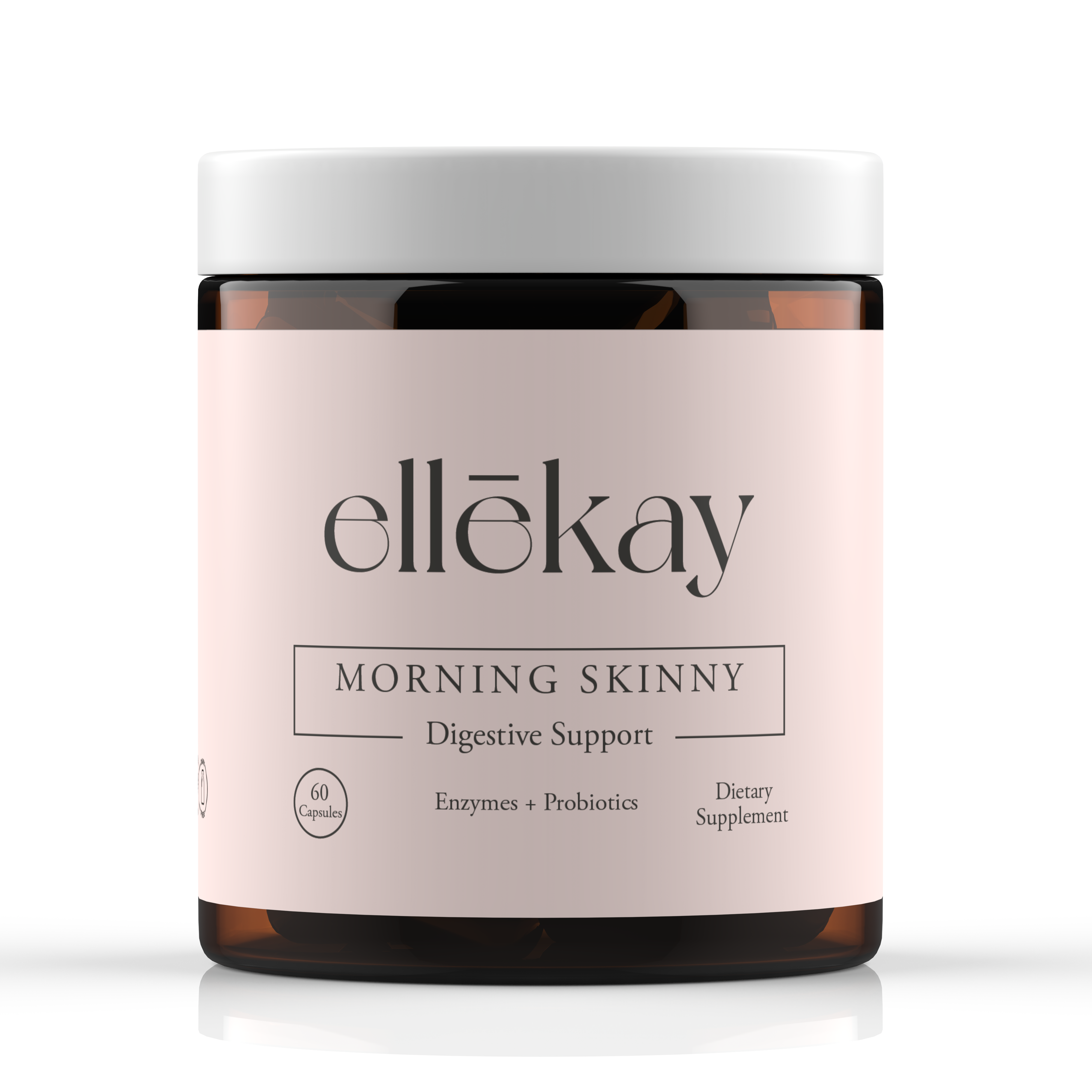
At Ellekay, gut health is at the center of how we think about how you feel each morning. Our Morning Skinny blend is designed to work with your body's natural overnight digestive rhythms, supporting the gut environment where bacteria like Akkermansia do their best work. For more on Ellekay's approach to wellness, visit our Contact page.
Frequently Asked Questions
What is Akkermansia muciniphila?
Akkermansia muciniphila is a gut bacteria that lives in the intestinal mucus layer and plays a central role in maintaining the gut barrier. It is classified as a next-generation probiotic because it performs a structural function no traditional Lactobacillus or Bifidobacterium strain can replicate: stimulating mucin production and restoring tight junction proteins that keep the gut lining sealed.
Is Akkermansia a probiotic?
Yes, though it is classified as a next-generation probiotic rather than a traditional one. Traditional probiotics like Lactobacillus work in the intestinal lumen. Akkermansia lives in the mucus layer of the gut wall and performs structural maintenance functions. The European Food Safety Authority granted approval for pasteurized Akkermansia as a novel food ingredient in 2021, the first next-generation probiotic to receive this regulatory recognition.
How does Akkermansia muciniphila support gut health?
Akkermansia supports gut health through three primary mechanisms: it stimulates goblet cells to produce more mucin, which thickens the protective mucus layer; it restores tight junction proteins (occludin, claudin-3) that seal gaps between intestinal cells; and its outer membrane protein Amuc_1100 triggers anti-inflammatory signaling pathways through TLR2 receptors. Together these mechanisms reduce intestinal permeability and systemic inflammation.
What percentage of gut bacteria is Akkermansia?
In healthy adults, Akkermansia muciniphila typically represents 3 to 5 percent of the total gut microbiome. Research consistently finds that people with metabolic disease, type 2 diabetes, obesity, and inflammatory conditions have significantly lower Akkermansia levels, sometimes approaching undetectable in severely dysbiotic guts.
Can I take Akkermansia with other probiotics?
Yes. Akkermansia and traditional probiotics like Lactobacillus and Bifidobacterium are complementary rather than competing. They occupy different ecological locations in the gut and perform different functions. Many integrative gut health protocols recommend combining Akkermansia supplementation with a multi-strain traditional probiotic for comprehensive gut microbiome support.
Written by the Ellekay Wellness Team | Reviewed by our gut health research advisors | Published April 2026 | Sources: Nature Medicine (2019), PMC Gut Microbiota for Health (2022), European Food Safety Authority Novel Food Authorization (2021), Frontiers Microbiology (2024)
Related guides